Why Talk About Protein Skimmers
In the world of aquarium keeping especially in the saltwater and reef hobby a handful of tools and pieces of equipment are considered indispensable. Heaters filters and lights are the obvious ones without them most fish and corals wouldn’t survive for long. But among this essential gear, there is one piece of equipment that sparks equal measures of fascination, debate, and sometimes confusion the protein skimmer.
Ask a beginner what a protein skimmer is and they might describe it as that tube that makes bubbles. Ask an experienced reefer and they’ll likely tell you it’s the heart of nutrient export the line of defense against organic buildup algae blooms and cloudy water. Some aquarists swear that no reef tank can thrive without one others argue they’re optional if you master natural methods like refugiums or frequent water changes.
<script async type="text/javascript" src="https://n1.smartyads.com/?c=b&t=s&placementId=9622&ua=[UA]&ip=[IP]&gdpr=[GDPR]&gdpr_consent=[GDPR_CONSENT_534]&gpp=${GPP_STRING_534}&gpp_sid=${GPP_SID}&coppa=[COPPA]&page=[PAGE]&lmt=[LMT]&dnt=[DNT]&ad_width=[AD_WIDTH]&ad_height=[AD_HEIGHT]"></script>
So what exactly is a protein skimmer and why does it matter so much in saltwater aquariums To answer that we need to dive deep into both the science and the practical aspects of how they work. A protein skimmer is not just a bubble-maker it is a device that relies on physics chemistry and biology to physically remove organic waste before it ever has a chance to break down into harmful compounds.The principle is elegant create a massive interface of air and water encourage waste molecules to cling to air bubbles then transport those bubbles to a collection cup where the gunk can be removed from the system. The result is cleaner water happier fish healthier corals and an aquarium that looks and smells better.
What Is a Protein Skimmer
At its core a protein skimmer also called a foam fractionator is a device used in aquariums to remove organic compounds from water before they decompose. These compounds include proteins amino acids fatty acids and other waste materials produced by fish corals invertebrates and uneaten food.
The idea is simple waste sticks to bubbles. When you create a storm of microbubbles in water dissolved organic compounds DOCs naturally attach to the air-water interface. As these bubbles rise they carry the waste upward into a foam which is then collected in a cup or chamber. By physically removing the waste a skimmer prevents it from breaking down into ammonia nitrite nitrate and phosphate all of which fuel algae growth and stress aquatic life.
The process sounds like magic but it is actually rooted in physics and chemistry. Molecules that are hydrophobic repelled by water tend to cling to air bubbles. Proteins and other organics in aquarium water often have these hydrophobic regions. By creating the right bubble density and contact time a skimmer harvests these compounds and physically exports them from the system.
This is why protein skimmers are often described as nutrient export machines. They don’t replace biological filtration or water changes but they dramatically reduce the organic load making the rest of the filtration system’s job easier.
Why Protein Skimmers Matter in Aquariums
For freshwater aquariums protein skimmers are rarely used. That’s because the surface tension of freshwater is different from saltwater and it’s much harder to generate stable foam. In saltwater however foam forms easily which is why the ocean naturally produces seafoam along beaches a phenomenon identical to what happens inside your skimmer.
For marine aquariums especially those housing sensitive corals clams and invertebrates protein skimmers offer several key benefits
Waste Removal Before Breakdown
Skimmers remove organic waste before bacteria can break it into ammonia and nitrate. This reduces the overall nutrient load.
Nitrate and Phosphate Control
By reducing organics skimmers help prevent the buildup of nitrates and phosphates that fuel algae blooms.
Oxygenation of Water
Skimmers inject large amounts of air into the system increasing gas exchange and raising oxygen levels.
pH Stability
Because they boost oxygen and reduce dissolved CO₂ skimmers can help stabilize pH levels.
Crystal-Clear Water
Skimmers remove fine particles and dissolved substances that can cloud water resulting in greater clarity.
Better Smell
A tank with an efficient skimmer smells fresher since odor-causing compounds are exported.
Support for Heavy Bioloads
Tanks with many fish or frequent feedings benefit from the extra nutrient export.
A protein skimmer is both a luxury and a necessity depending on the type of tank you run. For a reef system full of corals, it’s almost essential. For a fish-only system with light stocking it’s optional but still highly beneficial.
How Protein Skimmers Work The Science Behind the Foam
Understanding a skimmer means understanding how bubbles interact with organic molecules. Let’s break down the process step by step.
Air Injection
The skimmer introduces air into a column of water usually by means of a pump venturi valve or wooden airstone. The goal is to create tiny bubbles the smaller the better.
Bubble-Water Contact
As the bubbles rise they provide an enormous surface area. Organic molecules in the water attach to this air-water interface because of their hydrophobic regions.
Foam Formation
When enough organics coat the bubbles they form a sticky foam. This foam gathers at the top of the skimmer’s chamber.
Waste Collection
The foam overflows into a collection cup at the top of the skimmer where it condenses into a dark liquid known as skimmate. This skimmate is rich in proteins fats and other organic gunk.
Removal from System
By discarding the skimmate aquarists physically remove the waste from the tank reducing the overall nutrient load.
This process is continuous and efficient running 24/7 in most reef aquariums.
Types of Protein Skimmers
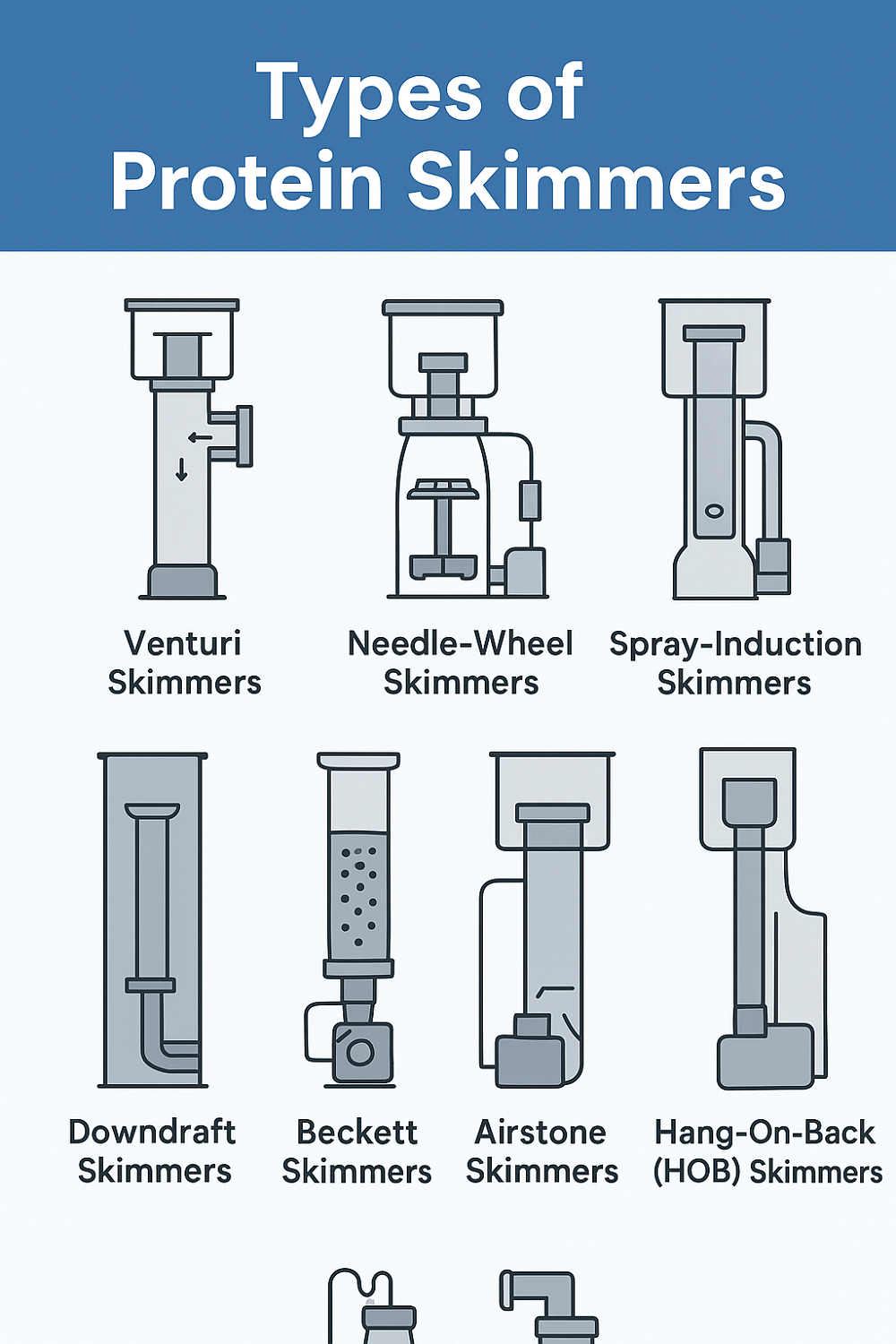
Protein skimmers come in many designs. Over the years hobbyists and engineers have developed different methods of producing fine bubbles and controlling foam. Let’s explore the major types.
Venturi Skimmers
Use a venturi valve to inject air into water under pressure.
Reliable and effective but require a strong pump.
Needle-Wheel Skimmers
Use an impeller with needles or pins to chop incoming air into microbubbles.
One of the most popular designs due to efficiency.
Spray-Induction Skimmers
Use a high-pressure pump to spray water into a chamber mixing air and water.
Powerful but energy-hungry and noisy.
Downdraft Skimmers
Force water at high speed down a tall tube filled with bioballs or media creating bubbles.
Large effective for big tanks but bulky.
Beckett Skimmers
Use a Beckett foam injector to produce massive quantities of bubbles.
Powerful and efficient but require strong pumps.
Airstone Skimmers
Use wooden airstones to produce fine bubbles.
Old-fashioned but still effective on smaller systems.
In-Sump Skimmers
Designed to sit inside a sump below the aquarium.
Popular due to ease of use and integration.
Hang-On-Back HOB Skimmers
Hang directly on the back of the tank no sump required.
Great for small systems or beginners.
Each type has its pros and cons which we’ll explore in more detail later.